
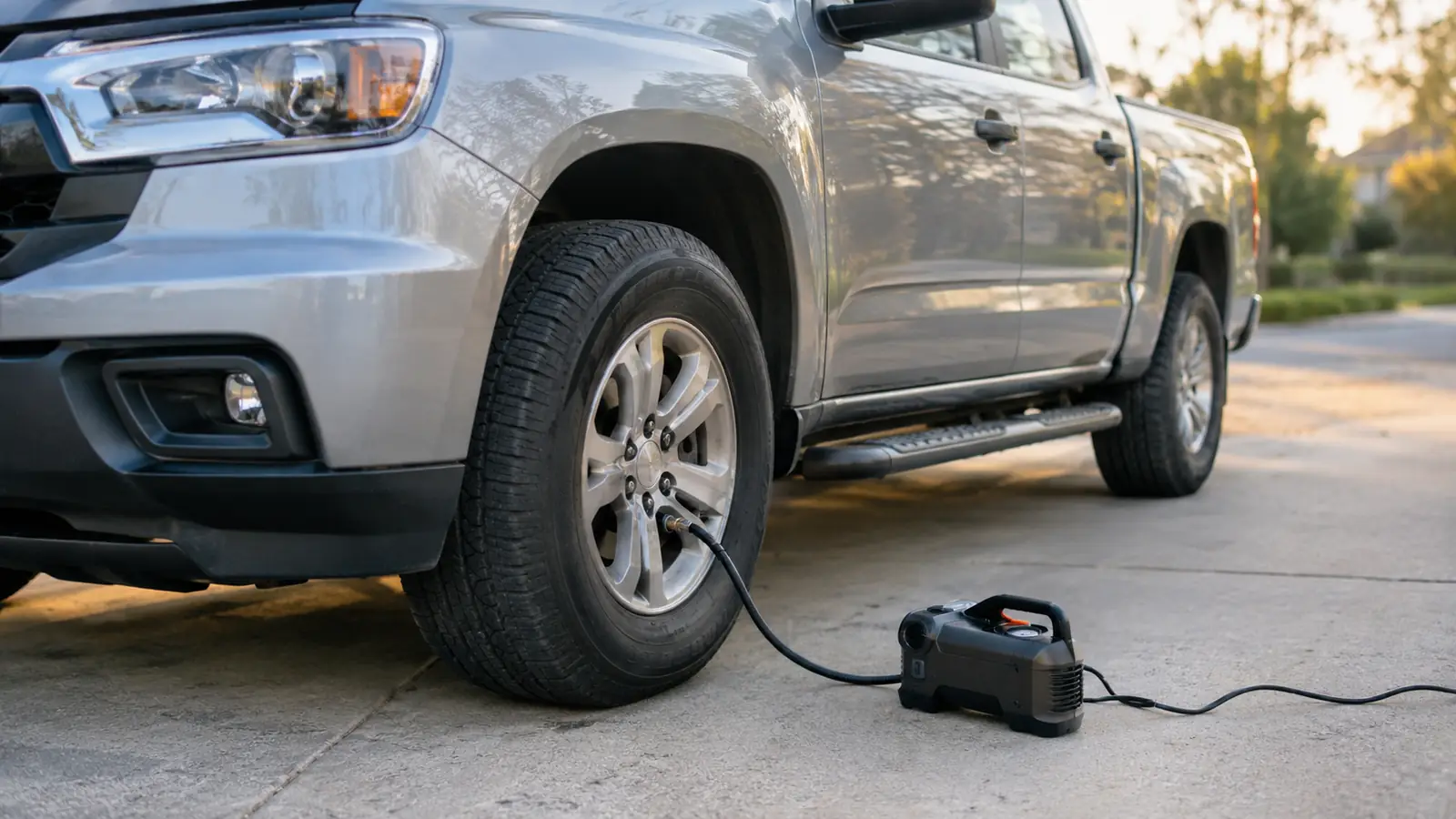
A pickup truck is the one vehicle where tire pressure actually changes with the job. Empty, my 2016 F-150 rides on 35 PSI front and rear. The day I hook up a trailer or load the bed with gravel, the rear tires need 40. If I set the rear at 40 and drive empty for a week, the middle of the tread wears out and the ride turns harsh. If I set it at 35 and haul a load, the sidewalls flex too much and the tires run hot. The right number is not a guess and it is not the number molded into the sidewall. It is printed on a sticker in the driver's door jamb, and it changes with what you are doing that week. That is what this guide covers, and I will show you the exact routine I use with the AstroAI AIRUN H tire inflator in my own driveway.
I have been turning wrenches for about 30 years, and I still see trucks come through the shop with 50 PSI in the rear because somebody read the max pressure off the sidewall. That number is the ceiling for the tire, not the target for your truck. The door sticker is the target. This guide walks through the whole process: reading the sticker, checking pressure cold, setting it with a portable inflator, and rechecking after the tires warm up.
The inflator I keep in the truck for this exact job
The AstroAI AIRUN H plugs into the 12V outlet, shuts off automatically at the PSI you set, and has a digital gauge that agrees with my shop gauge. It lives behind the back seat of my F-150 and has bailed me out more times than I can count.
Amazon Check Today's Price on Amazon →Step 1: Find the door sticker and read the cold pressure
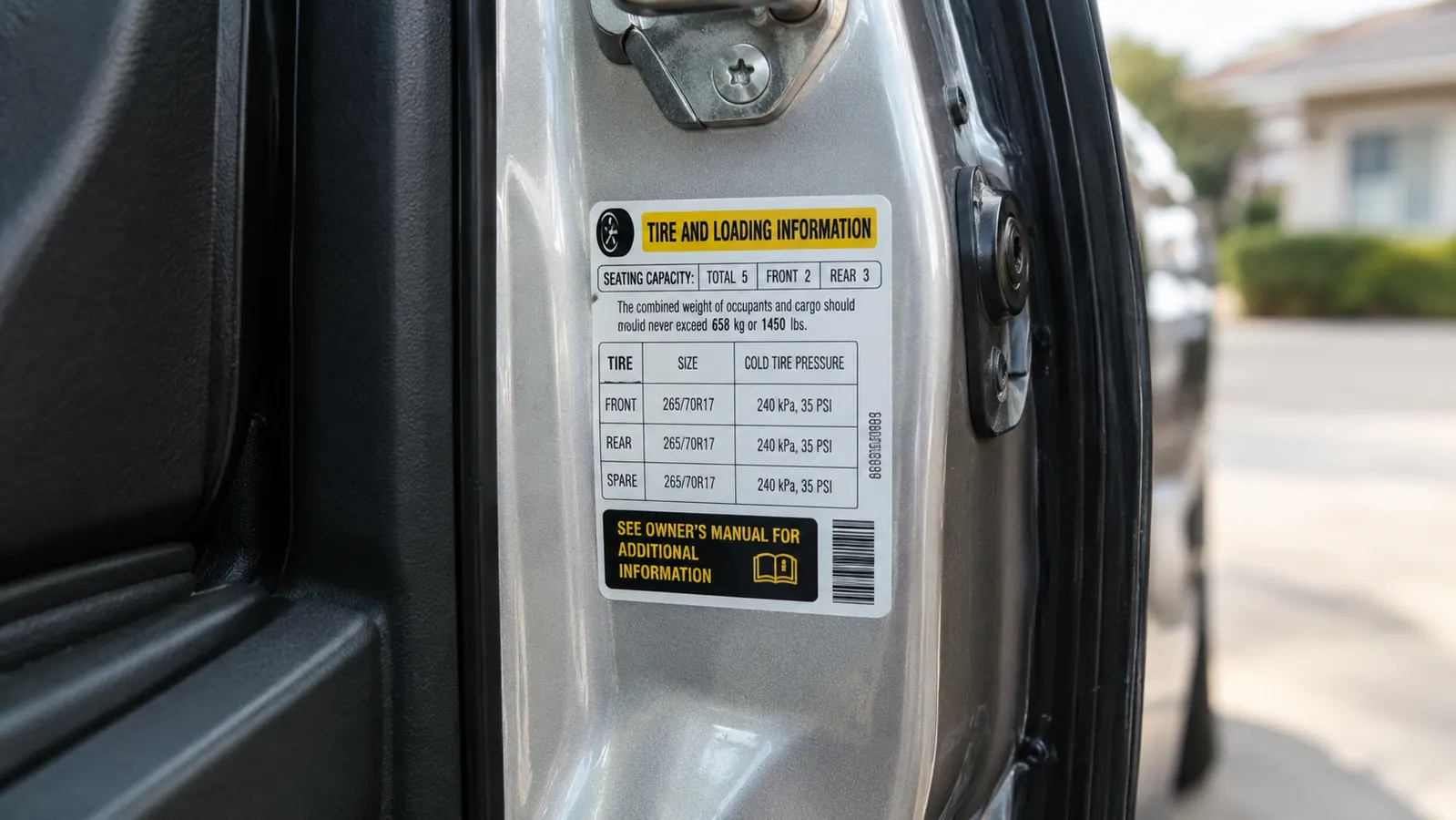
Open the driver's door and look at the latch area. There is a sticker with the vehicle's tire and loading information. On my F-150 it lists 35 PSI for the front and 35 PSI for the rear at normal load, and 40 PSI for the rear when towing or hauling. Your truck's sticker may be different. A half-ton Chevy or Ram will have its own numbers, and a 3/4-ton truck will have higher numbers because it carries more. The sticker is the only number that matters for your specific truck.
Cold means the truck has not been driven for at least three hours, or has been driven less than a mile. I check mine first thing in the morning in the driveway, before I start the engine. If you check after a 30-minute drive, the tires are warm and the pressure reads higher, sometimes 4 to 6 PSI higher. Setting pressure on warm tires means you will be low by that same amount once they cool down. If you have no choice but to check warm, add 4 PSI to the sticker number and set it there.
One thing I tell customers: do not use the number on the sidewall. The sidewall says max pressure, often 50 or 80 PSI for a light truck tire. That is the pressure the tire can physically handle, not the pressure your truck needs. Running at max pressure makes the center of the tread carry the load, so the tires wear out in the middle and the ride gets stiff. The door sticker exists because the manufacturer tested the truck and found the pressure that balances wear, ride, and load capacity.
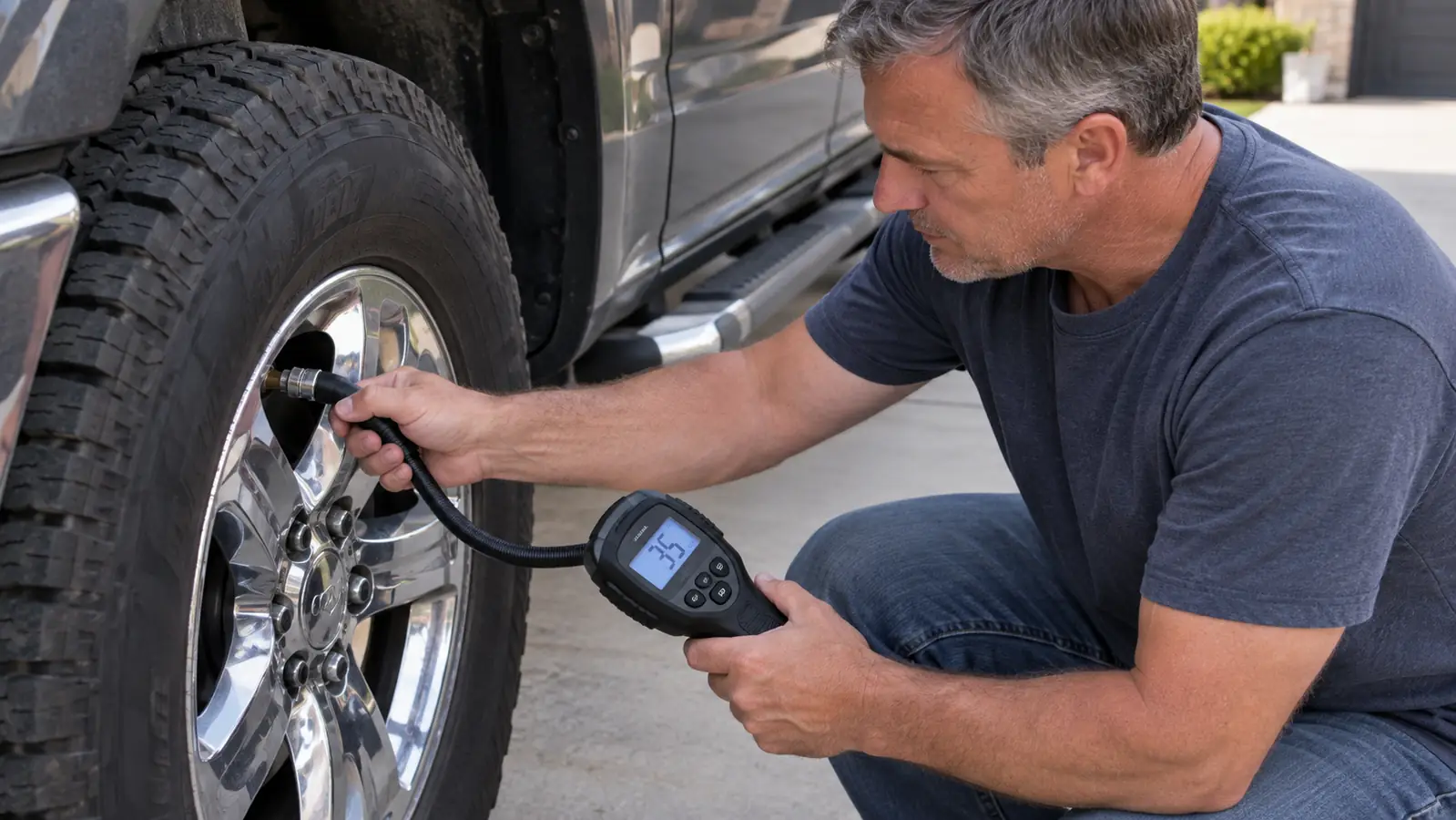
Step 2: Check the pressure with a gauge you trust
Before you add air, you need to know what you are starting with. I use the digital gauge on the AstroAI AIRUN H, and I have checked it against my shop's calibrated gauge. It reads the same, which is more than I can say for the pencil-style gauges that have been sitting in glove boxes since the 1990s. A gauge that reads 4 PSI high will have you running low forever, and you will never know it because you are trusting the tool.
To check, unscrew the valve cap, press the chuck straight onto the valve stem, and listen for a hiss. A small hiss when you first seat the chuck is normal. A steady hiss means the chuck is not seated, and you are reading the air escaping instead of the pressure in the tire. On the AstroAI, the digital readout settles within a second or two. Write down the number for each tire. I check all four, including the spare, because a spare that is 20 PSI low is useless when you need it at 10 PM on the side of the highway.
If a tire is low by more than 10 PSI, look at it before you fill it. A tire that is 15 PSI low on a Tuesday and 15 PSI low again on Friday has a slow leak, and adding air is only a temporary fix. I have seen valve stems dry out, beads corrode where they seat on the wheel, and nails that were too small to hear but big enough to lose 2 PSI a day. Fill it to get home, then find the leak.
Step 3: Set the target pressure on the inflator
The AstroAI AIRUN H has a digital display and buttons to set the target pressure. I set it to the door sticker number, 35 PSI for normal driving. The inflator shuts off automatically when it reaches that number, so I do not have to stand there watching the gauge and guessing. That auto shut-off is the feature that makes this tool worth keeping in the truck. With a manual pump or a gas station air hose, you are always overshooting or undershooting, and then you are letting air out or going back for more.
The unit runs off the 12V outlet, and the cord is 9.8 feet, which reaches all four tires on my F-150 without me having to move the truck. I plug it in, set the pressure, and start the engine so the compressor gets full power. The first time I used it, I set the target, pressed the button, and walked around to check the other tires while it filled the first one. It stopped right at 35. That is the experience you want, especially on a cold morning when you do not want to kneel in the gravel any longer than you have to.
If you are filling a tire that was very low, the compressor runs longer and the hose can get warm. That is normal. The AstroAI has an LED light on the unit, which I have used more than once when a tire was low at dusk and I did not want to drag a work light out to the driveway. It is bright enough to see the valve stem and the gauge, and it turns the job from a two-person operation into a one-person one.
Step 4: Fill to the number, then check it again
When the inflator shuts off, pull the chuck off and check the pressure one more time with the gauge. The act of removing the chuck can let out a pound or two, especially if you are in a hurry. I have seen a tire read 35 on the inflator and 33.5 on the gauge a second later. That half pound does not matter for daily driving, but it matters if you are setting the rear tires to 40 for a long tow, because you want the tires to start at the right number and build from there.
If the reading is low, put the chuck back on and top it off. If it is high, press the little pin in the center of the valve stem with the back of the chuck or a valve tool to let out a puff of air, then recheck. This is the step most people skip, and it is the step that separates a truck that rides right from one that wanders down the highway. A tire that is 5 PSI low on one side and 5 PSI high on the other will pull, wear unevenly, and make the truck feel loose in the corners.
I also check the pressure again after the truck has been driven. On a hot Oklahoma summer day, the tires will gain 3 to 5 PSI from heat alone. That is normal and you should not let air out of a hot tire. The pressure that matters is the cold pressure. If you set 35 cold and it reads 39 after a 30-mile drive, that is the system working the way it was designed to work.
Step 5: Adjust for load, towing, and the seasons
The door sticker gives you the number for normal driving, but a pickup truck earns its name when the bed is full or a trailer is hooked up. On my F-150, the sticker says the rear tires should go to 40 PSI when towing or hauling. I do that every time I hook up the trailer, and I drop it back to 35 when I am done. It takes two minutes with the AstroAI, and it keeps the rear tires from overheating on a long pull.
Seasonal temperature swings matter too. For every 10 degrees the air temperature drops, tire pressure drops about 1 PSI. That is why the low tire light comes on in November. In Tulsa, I set my tires in October and again in April, and I check them more often in the winter. A tire that was 35 PSI in September can be 31 PSI in January, and at 31 PSI the tire runs hotter, wears faster, and handles worse in the rain.
The last thing I check is the spare. I set it to the highest pressure listed on the door sticker, because a spare sits in the truck for months and loses pressure slowly. When I finally needed my spare two winters ago, it was at 22 PSI and I had to fill it before I could use it. Now I check it every time I check the other four, and I keep the AstroAI in the truck so I can do something about it.
What Else Helps
A good tire pressure gauge is the start, but a few other things make the job easier. A valve stem cap with a built-in gauge lets you check pressure without a separate tool, though I still trust a real gauge for the final number. A small tire tread depth gauge costs a few dollars and tells you when the tires are wearing evenly. And a 12V outlet splitter means you can run the inflator and a phone charger at the same time, which matters on a road trip when the kids are in the back seat and the phone is at 10 percent.
I also keep a valve core tool in the glove box. It is a tiny piece of metal, about the size of a key, that lets you remove the valve core if you ever need to deflate a tire in a hurry, like when you are airing down for sand or snow. It costs almost nothing and takes up no space. The AstroAI AIRUN H handles the filling, the gauge handles the checking, and the valve core tool handles the rare occasion when you need to let a lot of air out fast.
The door sticker is the target. The sidewall is the ceiling. I have seen a thousand trucks with 50 PSI in the rear because somebody read the wrong number.
Set it once, trust it every time
The AstroAI AIRUN H takes the guesswork out of the job. Set the PSI, press the button, and it stops on its own. That is the whole routine, and it takes less time than finding the air hose at a gas station.
Amazon Check Today's Price on Amazon →