
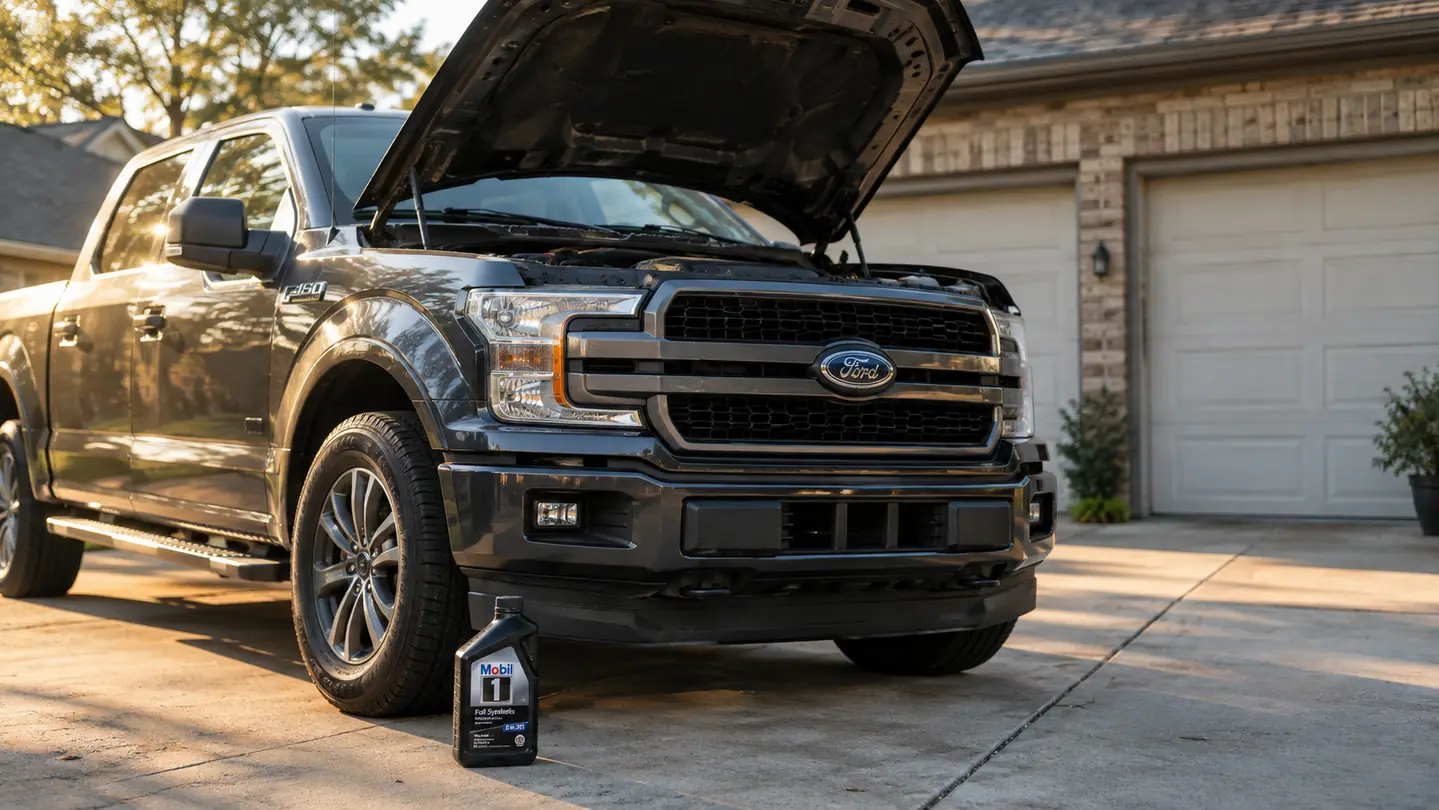
I have spent about thirty years with my hands inside other people's engines, and the question I hear more than any other at the shop is simple: is full synthetic oil actually worth the money, or is it just an upsell? Fair question. I do not sell oil changes anymore, so I have no reason to push the expensive jug. The short answer is yes. The long answer is the ten reasons below. I run Mobil 1 5W-30 in my 2016 Ford F-150 with the 3.5L EcoBoost V6, the truck has rolled past 140,000 miles, and it still does not burn a measurable amount of oil between changes.
Some of these reasons you already know. A couple of them only show up after you have run a full synthetic for years and then go back to conventional oil for one change and feel the difference yourself. I will walk through all ten the way I would explain them to a friend standing in my driveway in Tulsa, where the summer heat will expose any weakness in an oil fast.
The 5W-30 I Pour in My Own Truck
Mobil 1 Advanced Full Synthetic 5W-30 is the oil in my F-150 and the one I recommend to customers with turbocharged engines. Check today's price on Amazon.
Amazon Check Today's Price on Amazon →It Flows at Cold Start, When Your Engine Wears the Most
Most engine wear happens in the first thirty seconds after you turn the key, because the oil is still sitting in the pan. Conventional oil turns into something like cold honey at twenty degrees. Full synthetic stays fluid enough to reach the valve train almost immediately. Cold start is when the oil has to do the most work with the least help. The first start of the day is the one that matters most. That first minute of running decides how long the bottom end lasts. Last January we had a week of mornings in the teens here in Tulsa. My truck fired up with the oil pressure light out before I finished buckling my seatbelt. That is the difference you can feel, and it is the difference that saves bearings.

It Takes the Heat Without Thinning Out
Oil thins as it gets hot, and thin oil does not protect. That matters in a turbocharged engine in an Oklahoma summer, when the oil in the pan can see 220 degrees and the oil in the turbo lines gets hotter still. Conventional oil starts breaking down at those temperatures. Full synthetic holds its viscosity. Heat is the enemy of every lubricant, and Oklahoma has plenty of it. That is not a theory. That is what the teardowns show. I have seen the inside of enough engines to know what heat does over five thousand miles, and the oil that resists heat is the oil that keeps metal from touching metal in August.
It Keeps the Inside of Your Engine Clean
I have torn down engines with 180,000 miles on conventional oil that looked like they had been running on tar. Sludge builds up in the valve covers, clogs the oil pickup screen, and starves the bearings. Sludge is not a cosmetic problem. It is a lubrication problem. Full synthetic has detergents that hold contaminants in suspension so they drain out with the oil. When I change my own oil and cut open the filter, I want to see clean metal, not varnish. Mobil 1 has kept my EcoBoost clean enough that I am not embarrassed to show customers the valve covers.
It Lets You Change Oil Less Often, Safely
I still change oil on a schedule, but full synthetic buys you room. Conventional oil at 3,000 miles is usually done. Mobil 1 at 5,000 to 7,500 miles still has working additives left. For me that means one fewer oil change per year, and fewer oil changes means fewer chances to strip a drain plug or leave a filter loose. I have seen too many stripped drain plugs to want extra chances to make that mistake. The drain interval is where the cost difference pays you back. The synthetic jug is the more expensive one on the shelf, but the math comes out ahead when you count your own time and the mess.
It Adds a Small, Real Bump in Fuel Economy
Less friction means the engine does not work as hard. Full synthetic is slipperier than conventional oil, so you pick up a percent or two in fuel economy. On my truck that works out to maybe twenty or thirty more miles per tank, which is not going to change your life, but it adds up over a year of driving. I keep a logbook in the glovebox, so this is measured, not guessed. I reset the trip meter at every fill-up, so I can see the trend over months. I have seen the same effect on customer cars when they switch and track their mileage. It is a measurable bonus, not a sales pitch.

It Protects the Turbocharger, Where Oil Works Hardest
A turbocharger spins fast enough that the oil film is the only thing keeping the bearing alive. The 3.5L EcoBoost in my truck has two of them. Full synthetic holds a stronger film at the temperatures a turbo sees on a hot shutdown, which is exactly when conventional oil can coke onto the bearing. The oil is the only thing between that bearing and metal-on-metal. Turbos do not give you a warning before they fail. I have replaced turbos for customers, and I have never once wished I had used weaker oil in my own engine. This is where full synthetic earns its keep.
It Holds Up Under Load, Not Just Around Town
The oil in a commuter that idles through town does easy work. The oil in a truck that hauls and tows works hard, and hard work shears oil molecules apart. Conventional oil loses viscosity under sustained load. Full synthetic is built from uniform molecules that resist shearing. My truck is a daily driver, not a garage queen, and it earns its keep. The odometer does not care whether the miles were easy or hard. When I tow a loaded trailer to the dump on a Saturday morning, I do not want to wonder whether my oil just gave up halfway there. I want an oil that is still protecting when I get back.
Its Viscosity Stays Put for the Whole Interval
Oil does not just get dirty. It also gets thin as the additives that hold its grade break down. I have sent used oil samples from customer cars to a lab, and the full synthetics come back still in grade at 6,000 miles while conventional oils have sheared a grade thinner. That matters because the clearance between a bearing and its journal was designed for one specific viscosity. If the oil thins out, the metal gets closer to touching. Mobil 1 holds its 5W-30 rating for the full drain interval.
It Burns Off Slower, So You Add Less Between Changes
Every engine uses a little oil, especially a turbocharged engine with 140,000 miles. The question is how much. I check my dipstick every other fill-up, and I have gone the full interval without adding a quart. Customers who run conventional oil in the same engine are adding oil by the time they hit 4,000 miles. Slower burn-off also means the spark plugs and catalytic converter stay cleaner, because oil that burns leaves ash behind. It also means fewer trips to the parts store on a Saturday morning.
It Protects the Engine You Will Sell Someday
Trucks like mine end up with a second owner eventually. When they do, the buyer will not read the oil change records. They will listen for knocks and watch the smoke at startup. I have bought and sold enough trucks to know how buyers think. An engine that has run full synthetic its whole life has cleaner internals, less wear, and a better chance of a long second life. That is worth something even if you never sell, because it is the difference between a 200,000-mile truck that still runs right and one that is ready for the scrapyard.
What I'd Skip
If you drive an older engine that has run conventional oil its whole life and burns a quart every thousand miles, full synthetic is not going to undo that damage, and I will not pretend otherwise. I would also skip the pour-in additives and the so-called engine flushes that promise to fix years of neglect in one treatment. What I would not skip is full synthetic in a modern turbocharged engine. If your owner's manual calls for 5W-30 and you have a turbo, run a full synthetic and stop second-guessing it. That is the one place where the cheap jug is the expensive choice in the long run.
At 140,000 miles, my EcoBoost still goes the full interval without burning a quart. That is what full synthetic bought me.
The Oil I Trust at 140,000 Miles
Mobil 1 Advanced Full Synthetic 5W-30 is what I pour in my own truck and what I recommend to customers with turbocharged engines. Check today's price on Amazon.
Amazon Check Today's Price on Amazon →