
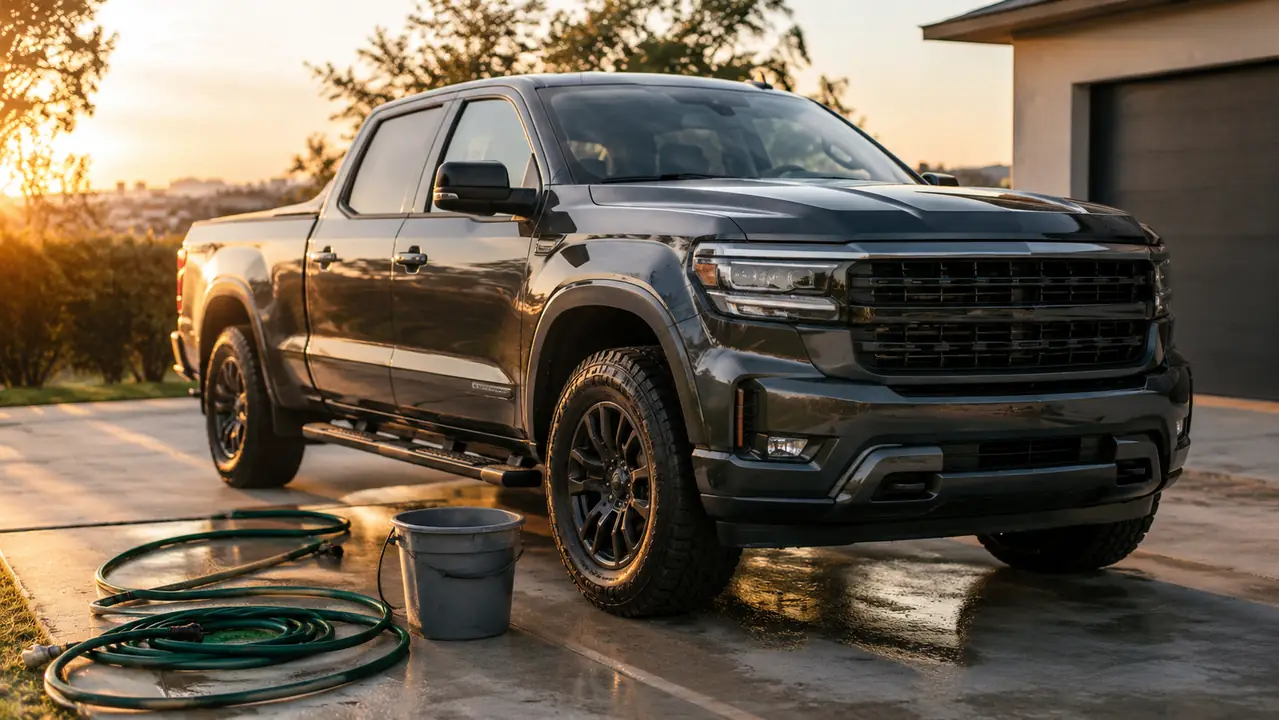
Every week somebody pulls into my shop with a pickup that looks fine from ten feet away. Then they catch it in the right light and the hood looks like a spiderweb, hundreds of tiny curved scratches that catch the sun. Nine times out of ten they tell me the same thing. They wash it every week. They take care of it. And they have no idea where the scratches came from. I know exactly where they came from. They came from the wash.
Most swirl marks never come from the road. They come from the person washing the truck. A grain of sand stuck in a sponge, a bath towel that spent a month on the garage floor, dish soap that strips the protection off the clear coat. Then the truck sits in the Tulsa sun and the paint takes the beating. I've been a working mechanic for about thirty years, and the soap I keep coming back to for my own truck is Chemical Guys Mr. Pink. My 2016 F-150 is past 140,000 miles and the hood still doesn't have that spiderweb pattern. Part of that is the method. Part of it is the soap.
The soap that doesn't fight your wax
Chemical Guys Mr. Pink is a pH balanced wash soap, not a detergent. It's slick enough that the mitt glides over the paint instead of dragging grit across it, it keeps dirt suspended in the bucket, and it won't strip the wax or sealant you already have on the truck. That's the whole job. If you're going to wash your truck without putting new scratches in it, start with a soap that doesn't undo your work.
Amazon Check Today's Price on Amazon →This is the method I use on my own truck, and it's the method I hand to anyone who asks. It takes about an hour on a regular Saturday, it uses stuff you mostly already own, and it works the same on a 20-year-old work truck and a brand-new one. Five steps, and none of them are complicated. The trick is the order and the patience.
Step 1: Rinse the truck before you touch the paint
The first mistake is touching the truck while it's still dirty. A pickup that's been on the road for a week has a layer of grit on every horizontal surface, and the lower panels are worse. If you wet a mitt and start wiping, that grit gets dragged across the clear coat like sandpaper. It doesn't take much. One pass with a gritty mitt and you've got a scratch that's going to be there until somebody polishes it out.
So the first step is a plain water rinse, no soap, no mitt, nothing touching the paint. Take the nozzle off the hose, or set it to a wide spray, and knock the loose dirt off the truck. Start at the top and work down. Hit the grille, the wheel wells, the rocker panels, and the areas behind the wheels where the road spray collects. Give the truck a couple of minutes to soak if it's really dusty. You're not trying to get it clean with water alone. You're trying to get rid of the loose stuff so that when you do touch it, you're not dragging sand across the paint.
One thing I'll tell people at the shop: skip the pressure washer for this step if you've got a garden hose. A pressure washer is fine for knocking mud off, but at close range and a steep angle it can drive water and grit into the gaps around the trim, and it can lift a decal edge on an older truck. A garden hose with a decent spray pattern does the job without the risk. Save the pressure washer for the underside of the fenders and the frame rails, places where swirls don't matter.
Step 2: Set up a two-bucket wash, or lay down foam first
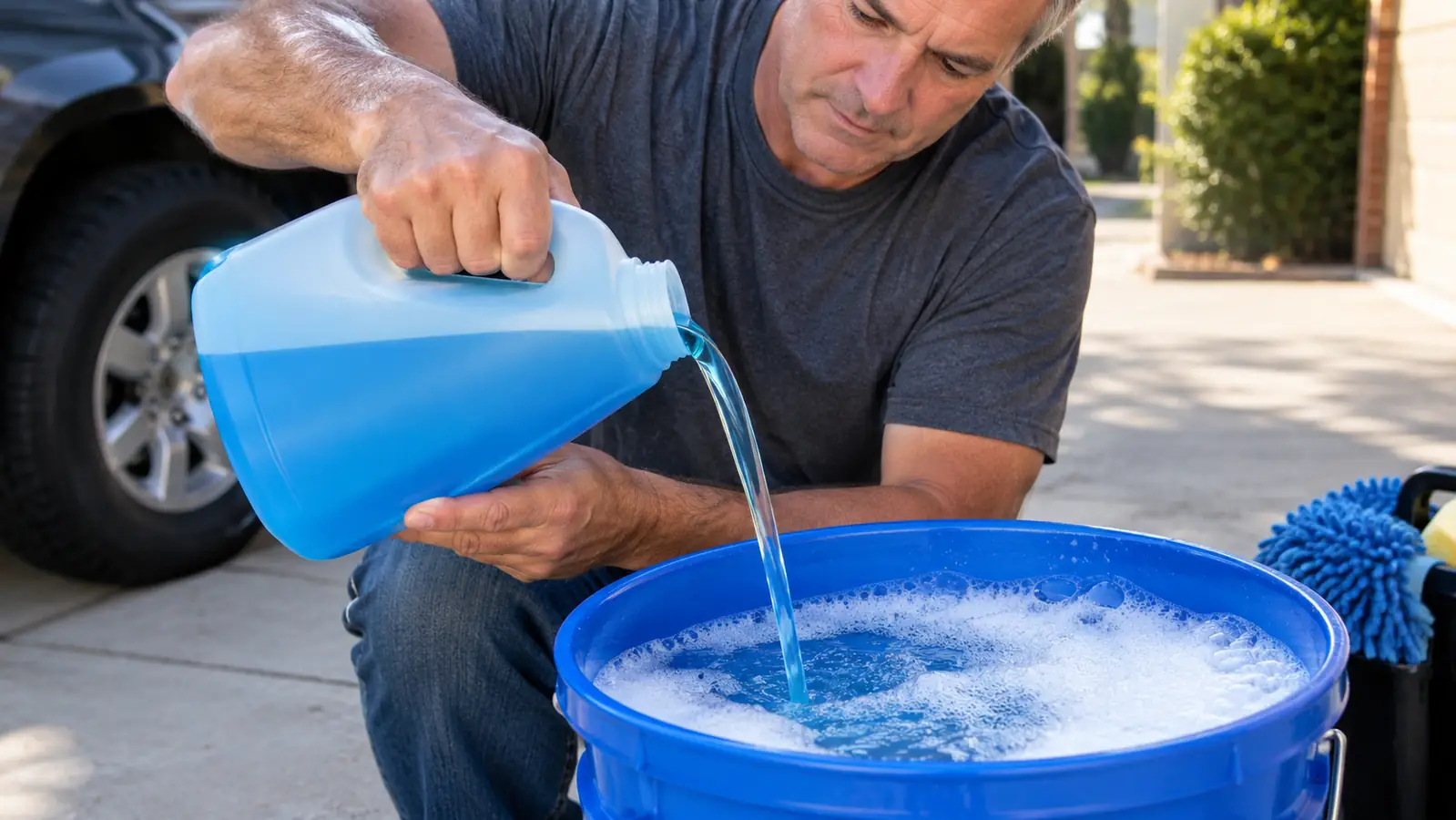
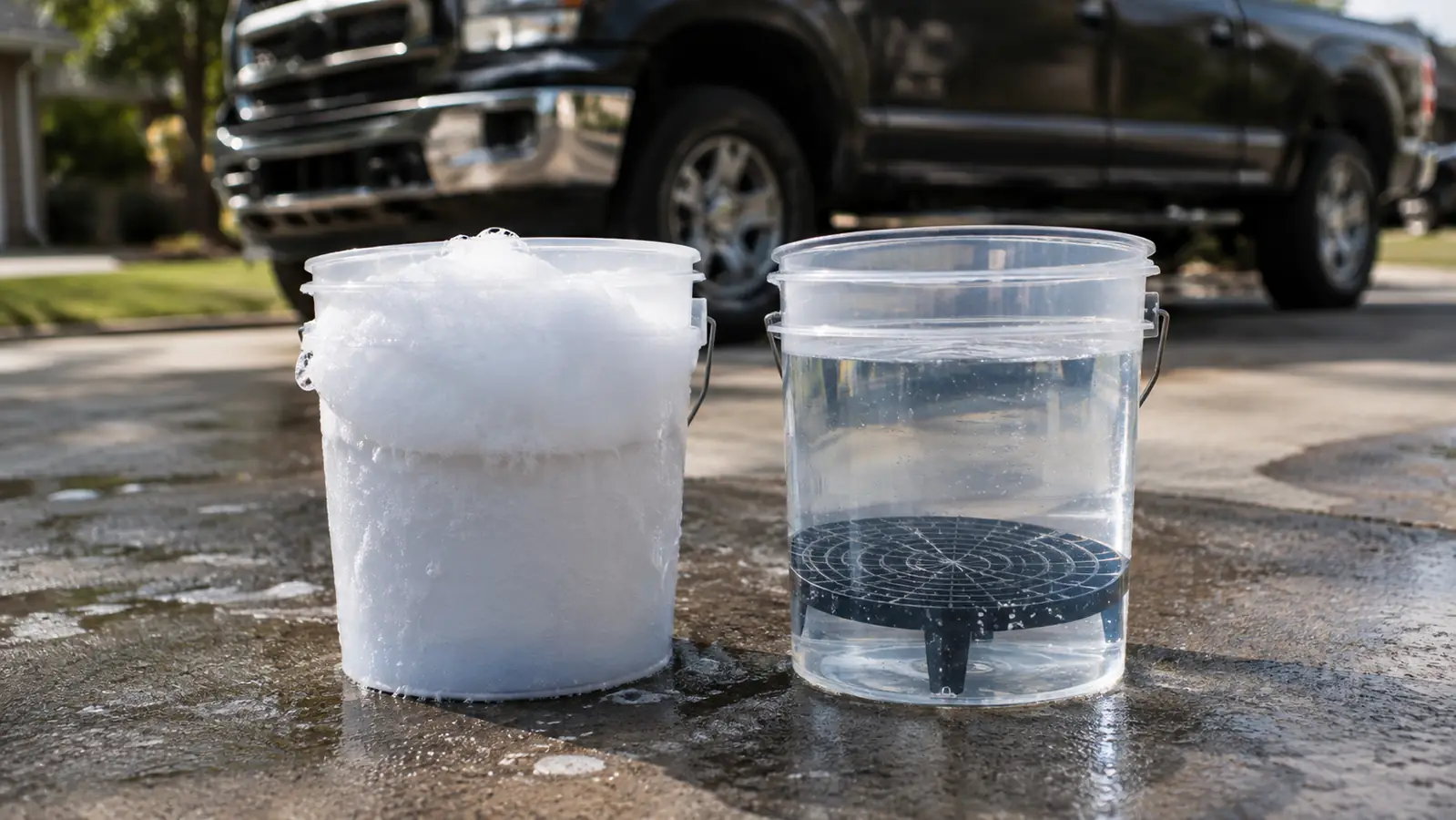
The single best thing you can do for your paint costs next to nothing. It's the two-bucket method. One bucket holds your soapy water. The other holds plain rinse water. You dip the mitt in the soap bucket, wash a panel, then dunk the mitt in the rinse bucket and agitate it a little before you go back for more soap. The grit that came off the paint settles in the rinse bucket and stays there. It never rides back up to the paint on your mitt.
A grit guard helps here. It's a plastic grid that sits in the bottom of the bucket, and the dirt sinks below it, out of reach of the mitt. Grit guards are cheap and they last forever. If you have a foam cannon, you can add a layer of foam on top of the two-bucket setup. The foam sits on the paint, lifts the dirt, and gives you a visual guide for where you've already washed. But the foam cannon is optional. Mr. Pink works exactly the way it should in a plain bucket, and the two-bucket method is what actually keeps the grit off the paint.
A note on the soap itself. Chemical Guys Mr. Pink is a concentrate, so a little goes a long way. If you pour in half the bottle, you'll spend the whole wash trying to rinse it off, and you'll still have soap residue in the crevices. Use the dilution on the label and trust it. It also doesn't strip the wax the way dish soap does, and it doesn't leave a film behind. That matters, because a truck that's been washed with dish soap looks dull until you put the protection back on.
Step 3: Wash top to bottom, one panel at a time
The order you wash in matters more than most people think. The lower half of a pickup carries the most dirt, especially the rocker panels and the areas behind the wheels. If you wash the rockers first and then move up to the hood, you're carrying that grit up with you. Wash the roof first, then the hood, then the upper sides, then the lower panels, and do the wheels and rockers last, with a separate mitt.
Work one panel at a time and rinse each panel before you move to the next. Wash the roof, rinse it. Wash the hood, rinse it. That way the soap never dries on the paint. In a Tulsa summer, soap can dry on a hot panel in under a minute, and dried soap leaves spots that are a pain to get off. If you're washing in direct sun, do half a panel at a time and keep the pace up.
Use straight lines, not circles. A straight scratch running front to back is hard to see and easy to buff out if you ever need to. A curved scratch catches the light from every angle, which is exactly the spiderweb look we're trying to avoid. Straight lines, front to back on the hood and the roof, top to bottom on the doors. It takes the same amount of time.
Step 4: Rinse with a sheet of water, not a spray
When the wash is done, the rinse is where people rush. They grab the nozzle, hit the truck with a hard spray, and call it good. That leaves soap in the gaps and water beaded all over the paint. The better way is to take the nozzle off the hose completely and let the water run in one solid stream. Starting at the top of a panel, flood the panel with a sheet of water. The water carries the soap and any last grit down and off the paint.
The sheet of water also helps with the hard water we have here in Tulsa. When water sits on the paint in beads and dries, the minerals in it leave little white spots. A sheet rinse makes the water run off in bigger sheets instead of beads, so there's a lot less water left on the paint to dry. It's not a cure for hard water spots, but it cuts them way down, and it costs nothing.
If you have an air compressor, this is the time to use it. A low-pressure pass of air gets the water out of the gaps around the badges, the mirrors, and the tailgate handle, places a towel can't reach. Then whatever water is left runs out of those gaps clean instead of dripping down the paint and leaving streaks. If you don't have a compressor, a leaf blower on low works, or just skip it and dry the edges with the corner of your towel.
Step 5: Dry with a clean microfiber towel, and don't rub
The drying step is where most of the damage happens, because it's the last time the paint gets touched, and by then people are tired and in a hurry. A bath towel that's been in the laundry is full of lint and grit. An old t-shirt can scratch. A chamois that's been sitting in the trunk is holding every bit of dust it picked up last month. None of those belong on paint. Use a clean microfiber drying towel, and use it flat.
Lay the towel on the panel and pull it across, or blot the water up. Don't press down hard and rub in circles. The towel is going to pick up whatever tiny bit of grit is left on the paint, and if you drag it across the paint under pressure, you're right back to making scratches. A gentle pull with the towel laid flat lets the microfiber grab the water without dragging the grit.
If the water has already beaded up and started to dry, a spray detailer helps. Spray the panel lightly and dry it with the towel. That's a drying aid, not a wash soap, so don't reach for the Mr. Pink bottle for this step. It's a wash soap concentrate, and it's not meant to go on a dry truck. And if you can, do the whole wash in the shade. The truck will be cooler, the soap won't dry on the paint, and the water won't spot. On a hot afternoon, park the truck so the sun is behind you and work in your own shadow.
What Else Helps
A few things make the whole job easier, and none of them are expensive. A grit guard for each bucket, a stack of clean microfiber towels you keep separate from the shop rags, and a wash mitt instead of a sponge. A sponge holds grit in its pores and drags it across the paint. A mitt sheds it into the rinse bucket, especially a chenille mitt with a deep pile. If you're still using a sponge from the kitchen, that's the first thing I'd replace.
The other thing that matters is what's on the paint before you wash it. Mr. Pink won't strip your wax, but it won't add one either. If the paint is bare, the soap has nothing to protect, and no wash soap is going to fix that. If your truck hasn't been waxed or sealed in a long time, put a coat of wax or a sealant on it first, then keep it clean with a wash soap like this one. The wax is what makes the water bead and the dirt release, and it's what keeps the paint looking wet.
And one honest warning. If the truck already has swirl marks, no wash soap is going to remove them. Mr. Pink will keep new ones from getting added, which is valuable, but it won't polish out what's already there. That takes a compound or a polish and a buffer, or a detailer who knows what they're doing. I've seen a lot of guys buy a new soap and expect it to fix years of damage, and it doesn't work that way. Wash soap prevents. Polish cures. Both are worth doing.
I've washed my F-150 past 140,000 miles in this driveway, and the hood still doesn't have the spiderweb scratches. The method matters, and Chemical Guys Mr. Pink is the soap that lets the method work.
Wash your truck this weekend without putting a single new scratch in it
The method is five steps: rinse, two-bucket wash, top to bottom, sheet rinse, microfiber dry. The soap is Chemical Guys Mr. Pink. If you're ready to stop adding swirls every time you wash, this is the starting point I'd hand you. It's the same soap that's been on my driveway for years.
Amazon Check Today's Price on Amazon →