
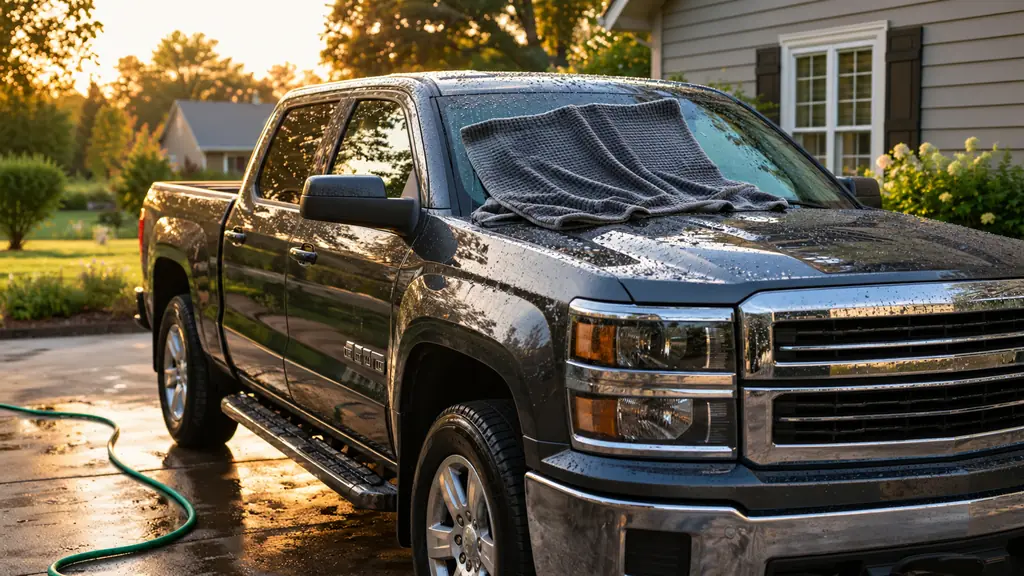
Tulsa water will spot a truck if you give it half a chance. I know because I wash my 2016 F-150 in the driveway most weekends, and our tap water here is hard enough that a few minutes of sun is all it takes for the minerals to bake themselves into the paint. The truck is silver, which hides a lot, but once you see white rings on the hood, you will see them every time you walk past. This is the problem I set out to solve, and the short version is that the answer is a good waffle weave microfiber towel, used the right way, in the right order.
I have tried paper towels, which scratch, a chamois, which pushes water around, and an old terry cloth towel that left lint and streaks. The drying towel that actually works for me is the Chemical Guys Waffle Weave Gray Matter, 25 by 36 inches. I have used it on my own truck for close to two years, and it still pulls water off the paint without leaving a spot behind. This guide walks through the exact five steps I use every time I wash the truck, from the rinse to the final pass.
The drying towel that ends the water spot fight
The Chemical Guys Waffle Weave Gray Matter is the 25 by 36 inch towel I keep in the garage for every wash. It lifts water off the paint instead of pushing it around, and it holds enough to dry the upper body of a full size truck with one towel. Check today's price on Amazon and see why it is the first thing I reach for after a rinse.
Amazon Check Today's Price on Amazon →The Five Steps I Use Every Wash
Step 1: Start with the Right Rinse
Most water spots do not start on the drying towel. They start at the rinse step. If you spray the truck with a fine mist and leave the water sitting in beads, every bead is a tiny magnifying glass that concentrates the sun and leaves a mineral ring when it evaporates. The trick is to sheet the water off the paint instead.
To do that, take the nozzle off the hose and let the water run in a wide, gentle stream. Start at the top of the cab and work your way down, flooding each panel until the water runs off in one continuous sheet rather than in droplets. A smooth, wet surface sheds water evenly, and the less water that stays behind, the fewer spots you have to chase with a towel.
On my truck I pay extra attention to the roof and the hood because they are the largest flat panels and the ones that dry fastest in the sun. I rinse those last, then move the truck into the shade while the water is still sheeting off. That gives me a running start before I ever pick up the towel.
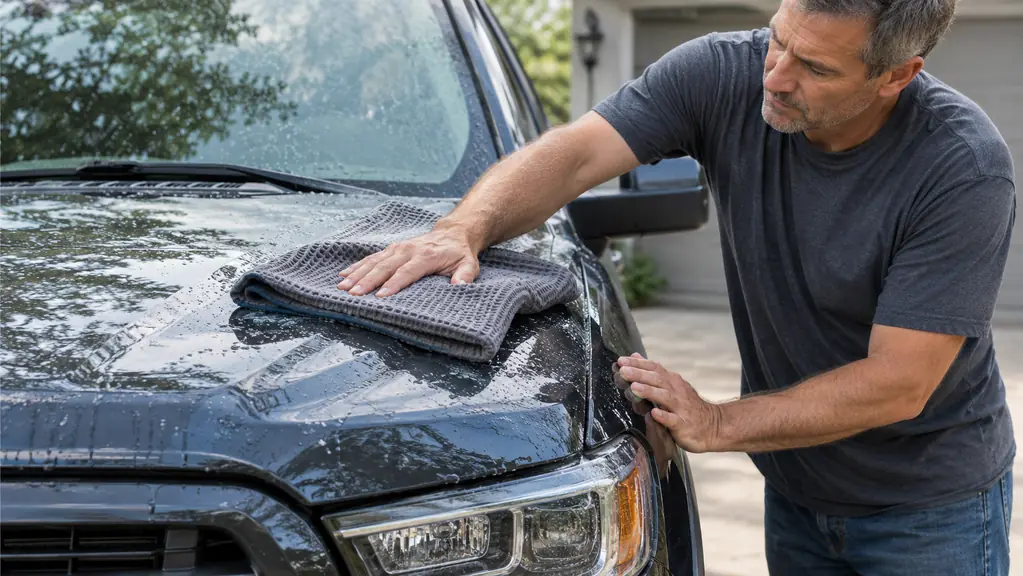
Step 2: Get the Truck into the Shade and Dry in Sections
Shade is not a luxury, it is part of the method. In a Tulsa summer, the pavement can push the temperature past 100 degrees, and a hot panel will flash dry in a couple of minutes. Once the water evaporates off a hot surface, the minerals stay behind and you are back to spots. So I pull the truck under the garage door opening or into the shade of the house before I dry a single panel.
Work in sections, and work top to bottom. I start with the roof, then the hood, then the fenders and doors, and I leave the rocker panels for last because they collect the most grit. The reason to go top to bottom is gravity. When you dry the roof first, any water that drips down lands on panels you have not dried yet, so you are never re-wetting a section you already finished.
Give yourself a time limit in your head. From the moment the truck is in the shade, I have maybe fifteen minutes before the water starts winning. That sounds like plenty, but a full size truck has a lot of surface area, which is why the towel you use matters as much as the order you use it in.
I learned the shade rule the hard way last July. I had a free afternoon, so I washed the truck at high noon and left it sitting in the driveway while I went inside for a glass of water. Ten minutes later the hood was dry, and it looked like someone had flicked a salt shaker across the paint. I spent the next hour with a detailer and a clean towel, chasing rings that had already set. Now the truck does not come out of the wash until the shade is ready for it.
Step 3: Use the Waffle Weave Towel with a Drag and Blot Motion
This is where the Chemical Guys Gray Matter towel earns its keep. The waffle weave pattern is not there for looks. The little squares create air pockets that pull water off the paint and hold it deep in the towel, so the towel keeps soaking up moisture instead of sliding across a wet surface and pushing the water around. A flat terry towel fills up fast and then just smears. A waffle weave towel keeps drinking.
At 25 by 36 inches, the Gray Matter is big enough to fold into quarters and give you eight dry sides. I lay it flat on the hood, fold it in half, then in half again, and I dry with a light dragging motion, not a scrub. You want the towel to glide over the paint and lift the water. Scrubbing does two bad things: it works the towel against the paint, which invites fine scratches, and it grinds any remaining grit into the clear coat.
Blot the tight spots. Around the mirrors, the door handles, and the edges of the hood, I press the towel down and lift it up instead of dragging it. That pulls the water out of the crevices without forcing it deeper into the gaps. When one side of the towel is damp, I flip to a fresh side. When all eight sides are damp, I switch to the second towel and keep going.
The size matters more than you would think. At 25 by 36 inches, the Gray Matter covers the F-150 hood in three or four passes. A smaller towel means more passes, and more passes means more chances to drag water across a panel that is already drying. I bought my first one in 2023 and it is still in the rotation. The waffle weave has held up through dozens of washes, and the edges have not frayed or rolled the way cheaper towels do.
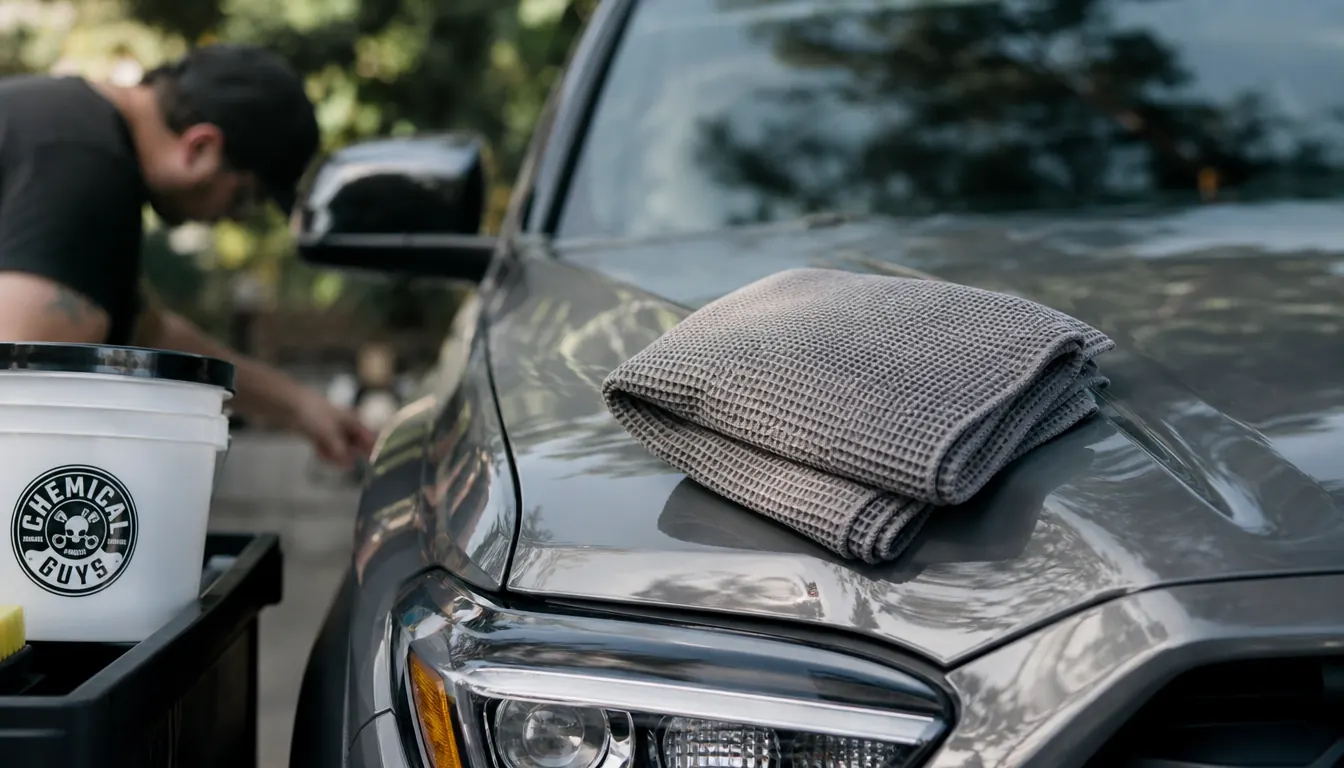
Step 4: Dry Top to Bottom, Then Swap to a Fresh Towel for the Lower Panels
The lower half of the truck is where drying goes wrong. The rocker panels, the lower doors, and the bumpers sit close to the road, so they pick up the dirt and grime that the wash did not fully remove. Using the same towel that just dried the roof on the lower panels is a good way to drag road grit across the paint. I keep my main towel for the upper body, then grab a second waffle weave towel for the lower panels.
This is also the step where most people rush. The water that collects around the door jambs, the tailgate handle, and the license plate recess does not evaporate fast, so it seems harmless, but it leaves the worst spots of all because it sits in a puddle and concentrates the minerals. I open the doors and tailgate and dry the jambs with the corner of the towel. It takes two extra minutes and it saves you a round of spot removal later.
If you drive a truck with a bed liner, dry the top edge of the bed and the tailgate top while you are in there. Water pools on those flat plastic edges and then runs down the paint when you drive off, leaving streaks that look like the truck was never dried at all.
I skipped the second towel once to see if it mattered. It did. The lower doors on the F-150 sit low enough that they pick up a film of grime even after a good wash, and by the time I finished the upper body, that grime had mixed with the water on the lower panels. The result was a faint haze on the bottom of the doors that showed up the next morning. Now I keep two Gray Matter towels in the wash bucket and I do not start until both are there.
Step 5: Chase the Leftovers with Air and a Detailer
After the towel pass, the truck should look dry, but it is not. The side mirrors, the emblems, the grille, and the wiper cowl all hide water that will run out and streak the paint ten minutes later. This is where my shop air compressor earns its keep. A quick blast of air at the mirror seams, the badge lettering, and the wiper blades blows the water out before it has a chance to move. If you do not have a compressor, a leaf blower does the same job, just a little louder.
For the stubborn spots that still show up, I keep a spray detailer in the garage. A light mist on the panel and a clean pass with a dry corner of the towel lifts the mineral deposit without needing to rewash the truck. Spray detailers are also handy for the glass. Water spots on the windshield are worse than paint spots because they catch the sun right in your line of sight.
The last thing I do is pull the truck out of the shade and look at it from an angle in full sun. That sounds fussy, but it is the only honest test. If I see a spot, I hit it with the detailer while it is fresh. Walking the whole truck in the sun takes one minute, and it catches the spots before they harden.
What Else Helps
The towel is the main event, but the rest of the routine matters too. Hard water is the real enemy, and Tulsa has some of the hardest water I have dealt with in thirty years of turning wrenches. If your water leaves white crust on your faucets, it is doing the same thing to your truck. A portable water softener or a deionizing filter on the hose takes the minerals out of the rinse, and that alone cuts the spotting problem by a wide margin. I use one when I do a full detail, and the difference is noticeable.
Beyond that, a drying aid helps. A few sprays of a quick detailer on the panel before you dry adds a little lubrication, so the towel glides easier, and it leaves a thin protective layer that makes the next wash easier. And keep your towels clean. A drying towel that still has wax or polish in it from last time will not absorb water the way it should. I wash my drying towels with a microfiber detergent and nothing else, and I never put fabric softener anywhere near them.
Time of day matters almost as much as the towels. In the summer I try to wash before the heat builds up or late in the evening when the sun is low. A cool truck dries slower, which gives you more time, and a low sun makes the spots easier to see while you are working. If I have to wash in the middle of the day, I park the truck in the garage with the door open and dry it right there.
A flat terry towel fills up fast and then just smears. A waffle weave towel keeps drinking.
Give your truck a spot-free dry this weekend
The Chemical Guys Waffle Weave Gray Matter is the towel I reach for every single wash. One 25 by 36 inch towel, folded into quarters, will dry the upper body of a full size truck, and a second one handles the lower panels. It has held up through two years of Tulsa summers in my garage. Check the current price on Amazon and keep one in your wash bucket.
Amazon Check Today's Price on Amazon →